You got a CP2000 about gambling income. Here's what's actually happening.
The letter looks like a bill. It isn't one — and the number on it was almost certainly computed the most expensive way possible. Here's what the notice is, why it's usually inflated, and what a real response looks like.
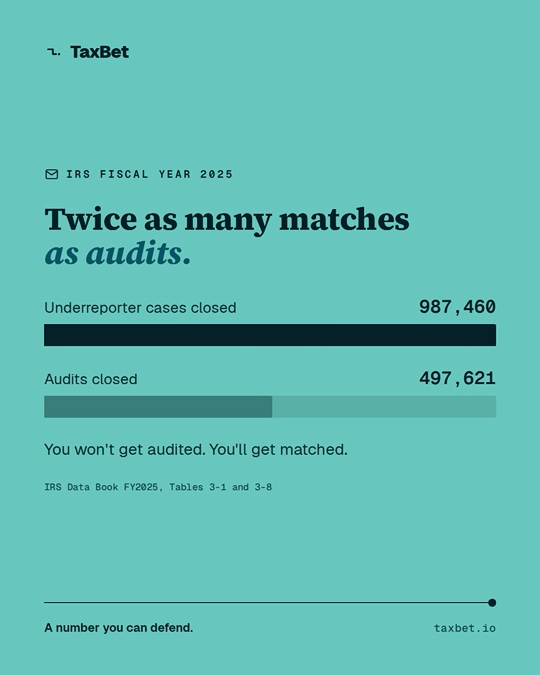
Twice as many matches as audits: 987,460 underreporter cases closed against 497,621 audits (IRS Data Book FY2025). You won't get audited — you'll get matched.
What the notice is
The IRS's computers matched the W-2G forms your casinos and sportsbooks filed against the income on your return and found a gap. A CP2000 (or the earlier-stage CP2501) is a proposed change — not a bill, not an audit. You have a response window: check the date printed on your notice and work from that. It's typically around 30 days from the notice date, but your notice is the authority, not a generic number on a web page.
Why gambling notices are usually inflated
The casino reported gross payouts — every qualifying win at the moment it happened, with no memory of what you wagered or lost that same day. The IRS proposal assumes every one of those dollars is income. The session method — the IRS's own framework (Chief Counsel Advice AM2008-011; Notice 2015-21) — groups your play into sessions and usually computes a much smaller number.
$49,100
Gross W-2G payouts — what the notice math starts from
$8,200
Session-method taxable income, itemizing — the same year, computed correctly
Illustrative — tax year 2024. Your real numbers come from your upload.
What NOT to do
Don't ignore it. No response generally converts the proposal into a statutory Notice of Deficiency — a much harder process with fewer options.
Don't just pay it. The proposed amount is typically computed from gross W-2G figures with no session analysis and no losses. Check whether it's right before you pay anything.
Don't argue the W-2G is "wrong." It almost never is. The form is gross-accurate and context-blind — it reports the payout, not your income. The fix isn't disputing the form; it's computing and documenting the correct session-based figure it belongs inside.
What a defensible response contains
A response that closes a matching notice is a complete corrected computation: a session-by-session reconciliation for the notice year, W-2G matching that shows exactly which sessions the forms landed in, corrected schedule figures, and documentation traced line-by-line to your transaction data. Partial responses — "here are my W-2Gs plus my losses" — can themselves misstate income. Most people hand the package to a CPA or EA for the response itself; the workpaper is what makes that engagement fast.
Check where you stand — free
Upload your exports for the notice year and the free directional check tells you whether the session method likely changes the IRS's number — before you spend a dollar. If it shows you genuinely owe what they say, we say so.
I got a CP2000 notice about gambling winnings. What is it?
A CP2000 isn't an audit and isn't a bill — it's a computer-generated proposal. The IRS matched the W-2Gs it received against your return, found a difference, and is proposing additional tax based on the assumption that the entire difference is unreported income. The proposal typically ignores your losses entirely, which is why the proposed amount often overstates what you actually owe — sometimes dramatically.
How long do I have to respond?
The response deadline is printed on your notice — typically around 30 days from the notice date. Don't ignore it: no response generally leads to a formal Notice of Deficiency and a much harder process. If you need more time, the IRS can often grant an extension if you contact them before the deadline.
Should I just pay the amount on the notice?
Not before checking whether it's right. The proposed amount is computed from gross W-2G figures with no session analysis and no losses. Many notice recipients owe far less than proposed — and some owe more than they think in a different direction if their return omitted non-W-2G winnings. The correct response is a complete, documented computation. TaxBet's free notice check shows you directionally where you stand before you spend anything.
What's the right way to respond?
With a complete corrected computation, not a partial one. A proper response package includes the full-year session reconciliation, the corrected income figure, loss substantiation, and documentation of methodology. Many people work with a CPA or EA for the response itself; TaxBet produces the workpapers that make that engagement fast and inexpensive.