The session method: why the forms and your income are two different numbers.
Every tax question about online gambling comes back to one distinction: the number the casino reports and a session-based figure are computed on different theories. This page is the whole story.
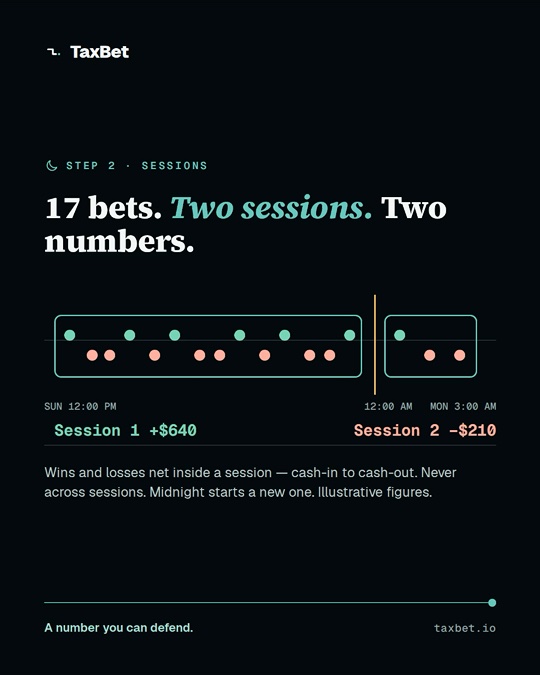
17 bets become two sessions and two numbers: wins and losses net inside a session, cash-in to cash-out, never across sessions; midnight starts a new one (illustrative figures).
What a session is
A session is one continuous stretch of play — at minimum one platform, one calendar day — and separated by game type where the authorities distinguish them (slots vs. table vs. sports). TaxBet computes both views; the default is set with professional review. Either way, you walk into a session with a bankroll and walk out with a result: up or down. That per-session result is the unit the session method works with. Not each spin, not each bet, and not each payout.
Under IRS guidance and case law (Chief Counsel Advice AM 2008-011; Notice 2015-21, a proposed safe harbor; Shollenberger v. Commissioner; Park v. Commissioner), a casual gambler's income may be measured by session rather than by adding up Forms W-2G. TaxBet documents that computation for you and your tax professional to review.
Why the W-2G total isn't your winnings
A W-2G fires on a single qualifying payout — at the moment it happens, with no memory of what you wagered before it or lost after it. Play a heavy year and the forms stack up even in sessions you finished down. Add them up and you get a number that looks like your winnings but isn't — it's a gross-payout tally, context-blind by design. The form isn't wrong — it's a record of one payout, not a measure of your income for the year.
$49,100
Gross W-2G payouts — what the forms total
$700
Session-method taxable income, itemizing — the same year
Illustrative — tax year 2026. Your own figures come from your upload.
Four ways to file the same year
Before the mechanics, the choice. A year of play can be filed under more than one defensible position, and the session method is one of them. The matrix below puts four side by side on a fictional sample year: what each reports, what it does to AGI, what it costs to substantiate, and the authority behind it. The full version, with scrutiny and state rows, is on the sample report.
What the session method does and doesn't change
For an itemizer whose losses exceed winnings, taxable gambling income is usually the same under both routes: losses up to winnings come off on Schedule A whether the winnings line carries the W-2G total or the session figure. The method changes four other things the gross route cannot.
AGI. Gross W-2Gs go into adjusted gross income in full; losses come off later, on Schedule A. Everything keyed to AGI — the child tax credit, IRMAA, the QBI deduction, ACA premium credits, the medical-expense floor, student aid, state conformity — is computed on the inflated number. Session winnings are a fraction of the W-2G total.
The 90% cap (tax year 2026 onward). Only 90% of losses are deductible. At gross, 10% of a large W-2G total becomes taxable income on a losing year. At session, 10% of a much smaller number.
Non-itemizers. Losses come off only on Schedule A. A standard-deduction filer reporting at gross pays tax on every W-2G; the session figure is the only relief.
Substantiation. When a reviewer asks for the diary (Rev. Proc. 77-29), the session ledger is the diary. The gross route has nothing to show.
How the method computes
Group the year's play into sessions. Sessions you finished up are winning sessions — their net gains sum to your gambling income, the figure that lands in your AGI. Sessions you finished down are losing sessions — deductible against that income, but only if you itemize, and for tax years beginning in 2026 only up to 90% of losses. Two numbers, both computed from your complete transaction record.
The authorities
This is a position with named authorities, not a trick. Chief Counsel Advice AM 2008-011 sets out per-session gain/loss computation; Notice 2015-21 proposed (but never finalized) a safe harbor formalizing per-session reporting for electronically tracked slot play; Shollenberger v. Commissioner (T.C. Memo. 2009-306) and Park v. Commissioner (D.C. Cir. 2013) are the case law. Casinos aren't required to apply a session view when issuing W-2Gs — which is exactly why the reconciliation has to be built from your records, and why your tax professional reviews the result.
The diary rule. The IRS has required a gambling diary since 1977 (Rev. Proc. 77-29); platform records already contain most of its elements — date, game, platform, amounts wagered and won or lost. Session computation is, in practice, that diary reconstructed from your exports.
Which position is right for you?
That is your preparer's call, and the matrix above exists to make it an informed one. The questions that usually decide it: do you have complete records from each platform you played on (without them, a session position cannot be substantiated); do you itemize (without itemizing, no position lets you deduct losses); and does your state offset wager cost (if not, the reported figure itself may be taxed). Rev. Proc. 77-29 sets the recordkeeping standard whichever position is chosen. Your tax professional determines your filing position.
What it takes to use it
Session computation needs your complete transaction history — every wager and every result, timestamped, from every book — organized into sessions and reconciled against the W-2Gs the IRS already has. Summaries and win/loss statements can't do it; transaction-level exports can. That reconciliation, documented and traced, is what TaxBet computes — for you and your tax professional to review. Session boundaries can involve judgment; TaxBet documents every assumption so the result can be reviewed.
Sports wagering.
Verification status
Open items in TaxBet's verification queue that touch this guide: the default session grain by game type (both grains are computed; the default is set with professional review), the ordering of the loss limitation against the winnings cap, and the wager-location day boundary. Each ships in the product as "pending verification" until a written response is on file. The review date and the sources are listed below.
Your transaction files never leave your device — everything is parsed and computed in your browser. Your account stores only the computed session summary that fills your dashboard, and you can delete it.