Draft — rates and treatments under review · not yet verified against every state DOR
Itemize-to-deduct states · 2026
Losses allowed if you itemize

Twenty-eight states and D.C. let you deduct gambling losses — if you itemize.

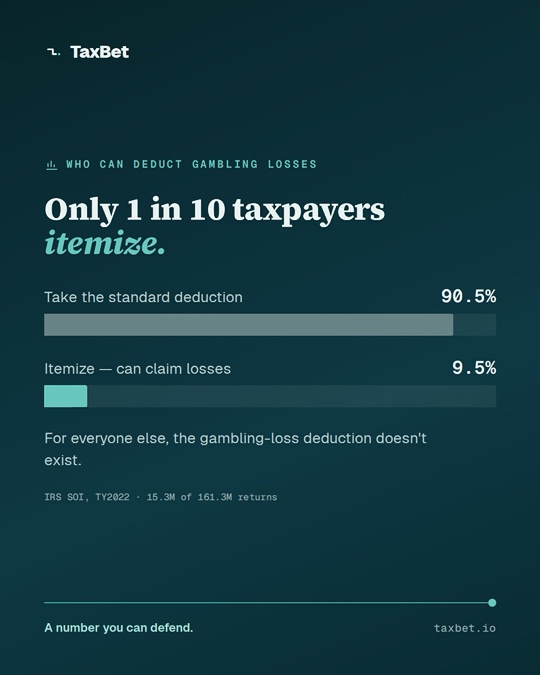
Most filers take the standard deduction — which means most filers in these states get no benefit from their losses at all.

29 states · every one detailed below · all groups
Only 1 in 10 taxpayers itemize: 90.5% take the standard deduction; 9.5% itemize and can claim gambling losses (IRS SOI, tax year 2022 — 15.3M of 161.3M returns).

How these states treat gambling

These states permit gambling losses to offset winnings up to the amount won, but only on an itemized return. For 2025 the federal standard deduction is $32,200 married filing jointly and $16,100 single — so unless your total itemized deductions clear that bar, your losses do nothing and your winnings are taxed in full at your state's rate.

Every state in this group

Open your state for its rate, its quirks, and what the same break-even year costs there.

Alabamaup to 5%

The same year everywhere: win $50,000, lose $48,000, walk away up $2,000. In Alabama, itemizers owe AL tax on $2,000; standard-deduction filers owe it on the full $50,000 — about $2,500 at up to 5%.

Graduated rates — the calculator's up to 5% default is an assumption to override.

Rate under review — confirm against the Alabama Department of Revenue before relying on it.

Arizona2.5% flat

The same year everywhere: win $50,000, lose $48,000, walk away up $2,000. In Arizona, itemizers owe AZ tax on $2,000; standard-deduction filers owe it on the full $50,000 — about $1,250 at 2.5% flat.

Arkansasup to 3.9%

The same year everywhere: win $50,000, lose $48,000, walk away up $2,000. In Arkansas, itemizers owe AR tax on $2,000; standard-deduction filers owe it on the full $50,000 — about $1,950 at up to 3.9%.

Graduated rates — the calculator's up to 3.9% default is an assumption to override.

Rate under review — confirm against the Arkansas Department of Revenue before relying on it.

Californiaup to 13.3%

The same year everywhere: win $50,000, lose $48,000, walk away up $2,000. In California, itemizers owe CA tax on $2,000; standard-deduction filers owe it on the full $50,000 — about $4,650 at up to 13.3%.

California has no legal sportsbook or online casino, but California residents still owe California tax on winnings from anywhere — including offshore and out-of-state play.

Graduated rates — the calculator's up to 13.3% default is an assumption to override.

Colorado4.4% flat

The same year everywhere: win $50,000, lose $48,000, walk away up $2,000. In Colorado, itemizers owe CO tax on $2,000; standard-deduction filers owe it on the full $50,000 — about $2,200 at 4.4% flat.

Rate under review — confirm against the Colorado Department of Revenue before relying on it.

Delawareup to 6.6%

The same year everywhere: win $50,000, lose $48,000, walk away up $2,000. In Delaware, itemizers owe DE tax on $2,000; standard-deduction filers owe it on the full $50,000 — about $3,300 at up to 6.6%.

Graduated rates — the calculator's up to 6.6% default is an assumption to override.

Rate under review — confirm against the Delaware Department of Revenue before relying on it.

District of Columbiaup to 10.75%

The same year everywhere: win $50,000, lose $48,000, walk away up $2,000. In District of Columbia, itemizers owe DC tax on $2,000; standard-deduction filers owe it on the full $50,000 — about $4,250 at up to 10.75%.

Graduated rates — the calculator's up to 10.75% default is an assumption to override.

Rate under review — confirm against the District of Columbia Department of Revenue before relying on it.

Georgia5.19% flat

The same year everywhere: win $50,000, lose $48,000, walk away up $2,000. In Georgia, itemizers owe GA tax on $2,000; standard-deduction filers owe it on the full $50,000 — about $2,595 at 5.19% flat.

Hawaiiup to 11%

The same year everywhere: win $50,000, lose $48,000, walk away up $2,000. In Hawaii, itemizers owe HI tax on $2,000; standard-deduction filers owe it on the full $50,000 — about $3,950 at up to 11%.

Hawaii is one of two states with no legal gambling of any kind.

Pending legislationA legislative working group has been examining online gaming authorization.

Graduated rates — the calculator's up to 11% default is an assumption to override.

Idaho5.3% flat

The same year everywhere: win $50,000, lose $48,000, walk away up $2,000. In Idaho, itemizers owe ID tax on $2,000; standard-deduction filers owe it on the full $50,000 — about $2,650 at 5.3% flat.

Iowa3.8% flat

The same year everywhere: win $50,000, lose $48,000, walk away up $2,000. In Iowa, itemizers owe IA tax on $2,000; standard-deduction filers owe it on the full $50,000 — about $1,900 at 3.8% flat.

Kentucky3.5% flat

The same year everywhere: win $50,000, lose $48,000, walk away up $2,000. In Kentucky, itemizers owe KY tax on $2,000; standard-deduction filers owe it on the full $50,000 — about $1,750 at 3.5% flat.

Allowed for tax year 2019 onward — it was disallowed for tax year 2018 only.

Source: Kentucky DOR — Form 740, Schedule A instructions

Maineup to 7.15%

The same year everywhere: win $50,000, lose $48,000, walk away up $2,000. In Maine, itemizers owe ME tax on $2,000; standard-deduction filers owe it on the full $50,000 — about $3,575 at up to 7.15%.

Maine's itemized deductions are capped at $36,300 and phase out above $100,000 / $200,050 of AGI — a large loss deduction can be cut down or lost entirely. Maine became the eighth iGaming state in January 2026 (Wabanaki Nations exclusive, one commercial partner each, 18% tax); live play is expected late 2026 or 2027.

Source: Maine Revenue Services — Form 1040ME, Schedule 2 instructions (itemized deduction cap and phase-out)

Graduated rates — the calculator's up to 7.15% default is an assumption to override.

Rate under review — confirm against the Maine Department of Revenue before relying on it.

Marylandup to 5.75% plus county tax

The same year everywhere: win $50,000, lose $48,000, walk away up $2,000. In Maryland, itemizers owe MD tax on $2,000; standard-deduction filers owe it on the full $50,000 — about $2,375 at up to 5.75% plus county tax.

Maryland county income taxes stack on top of the state rate, so your true marginal rate is higher than the state table suggests.

Pending legislationA Senate bill to authorize online casino gaming received a hearing and a $1.5B five-year revenue projection, but no vote.

Graduated rates — the calculator's up to 5.75% plus county tax default is an assumption to override.

Rate under review — confirm against the Maryland Department of Revenue before relying on it.

Massachusetts5.0% flat, plus 4% surtax above $1M

The same year everywhere: win $50,000, lose $48,000, walk away up $2,000. In Massachusetts, itemizers owe MA tax on $2,000; standard-deduction filers owe it on the full $50,000 — about $2,500 at 5.0% flat, plus 4% surtax above $1M.

Only losses at Massachusetts-licensed casinos, tracks, simulcast facilities and (TY2024+) Massachusetts-licensed sportsbooks are deductible; lottery and out-of-state losses never are.

Source: Mass. DOR — Form 1 instructions, Schedule Y (gambling losses at licensed Massachusetts establishments)

Pending legislationOnline casino legislation was tabled for study.

Rate under review — confirm against the Massachusetts Department of Revenue before relying on it.

Michigan4.25% flat

The same year everywhere: win $50,000, lose $48,000, walk away up $2,000. In Michigan, itemizers owe MI tax on $2,000; standard-deduction filers owe it on the full $50,000 — about $2,125 at 4.25% flat.

Allowed for tax year 2021 onward, but only if you itemize federally; nonresidents are limited to Michigan-source gains.

Source: Michigan Treasury — MI-1040 instructions (wagering losses)

Rate under review — confirm against the Michigan Department of Revenue before relying on it.

Minnesotaup to 9.85%

The same year everywhere: win $50,000, lose $48,000, walk away up $2,000. In Minnesota, itemizers owe MN tax on $2,000; standard-deduction filers owe it on the full $50,000 — about $3,925 at up to 9.85%.

Allowed on Schedule M1SA, but not when calculating Minnesota alternative minimum tax — filers with large winnings and matching losses are the most exposed.

Source: Minnesota DOR — Schedule M1SA and Schedule M1MT instructions

Graduated rates — the calculator's up to 9.85% default is an assumption to override.

Rate under review — confirm against the Minnesota Department of Revenue before relying on it.

Missouriup to 4.7%

The same year everywhere: win $50,000, lose $48,000, walk away up $2,000. In Missouri, itemizers owe MO tax on $2,000; standard-deduction filers owe it on the full $50,000 — about $2,350 at up to 4.7%.

Graduated rates — the calculator's up to 4.7% default is an assumption to override.

Rate under review — confirm against the Missouri Department of Revenue before relying on it.

Montanaup to 5.9%

The same year everywhere: win $50,000, lose $48,000, walk away up $2,000. In Montana, itemizers owe MT tax on $2,000; standard-deduction filers owe it on the full $50,000 — about $2,950 at up to 5.9%.

Graduated rates — the calculator's up to 5.9% default is an assumption to override.

Rate under review — confirm against the Montana Department of Revenue before relying on it.

Nebraskaup to 4.55%

The same year everywhere: win $50,000, lose $48,000, walk away up $2,000. In Nebraska, itemizers owe NE tax on $2,000; standard-deduction filers owe it on the full $50,000 — about $2,275 at up to 4.55%.

Graduated rates — the calculator's up to 4.55% default is an assumption to override.

New Mexicoup to 5.9%

The same year everywhere: win $50,000, lose $48,000, walk away up $2,000. In New Mexico, itemizers owe NM tax on $2,000; standard-deduction filers owe it on the full $50,000 — about $2,450 at up to 5.9%.

Graduated rates — the calculator's up to 5.9% default is an assumption to override.

Rate under review — confirm against the New Mexico Department of Revenue before relying on it.

New Yorkup to 10.9%

The same year everywhere: win $50,000, lose $48,000, walk away up $2,000. In New York, itemizers owe NY tax on $2,000; standard-deduction filers owe it on the full $50,000 — about $3,425 at up to 10.9%.

New York limits itemized deductions for higher earners, which can erode or eliminate the gambling loss deduction even though the state nominally allows it.

Pending legislationS2614 would authorize online casino gaming at a 30.5% tax rate. It is the fifth consecutive attempt.

Graduated rates — the calculator's up to 10.9% default is an assumption to override.

Rate under review — confirm against the New York Department of Revenue before relying on it.

North Carolina3.99% flat (TY2025)

The same year everywhere: win $50,000, lose $48,000, walk away up $2,000. In North Carolina, itemizers owe NC tax on $2,000; standard-deduction filers owe it on the full $50,000 — about $1,995 at 3.99% flat (TY2025).

New for TY2025 — if you already filed, you can amend. Session Law 2026-41 (SB 257, signed July 7, 2026) adds an itemized deduction for §165(d) wagering losses, retroactive to tax year 2025: 100% of losses for 2025, 90% for 2026 through federal conformity.

Source: N.C. Session Law 2026-41 (SB 257), ncleg.gov/BillLookup/2025/S257; NCDOR important notice on recently enacted legislation

North Dakota1.95% flat

The same year everywhere: win $50,000, lose $48,000, walk away up $2,000. In North Dakota, itemizers owe ND tax on $2,000; standard-deduction filers owe it on the full $50,000 — about $975 at 1.95% flat.

Rate under review — confirm against the North Dakota Department of Revenue before relying on it.

Oklahomaup to 4.75%

The same year everywhere: win $50,000, lose $48,000, walk away up $2,000. In Oklahoma, itemizers owe OK tax on $2,000; standard-deduction filers owe it on the full $50,000 — about $2,375 at up to 4.75%.

Gambling losses fall inside Oklahoma's $17,000 cap on all itemized deductions (charitable contributions and medical expenses are exempt from the cap).

Source: OAC 710:50-15-50

Graduated rates — the calculator's up to 4.75% default is an assumption to override.

Rate under review — confirm against the Oklahoma Department of Revenue before relying on it.

Oregonup to 9.9%

The same year everywhere: win $50,000, lose $48,000, walk away up $2,000. In Oregon, itemizers owe OR tax on $2,000; standard-deduction filers owe it on the full $50,000 — about $4,375 at up to 9.9%.

Graduated rates — the calculator's up to 9.9% default is an assumption to override.

Rate under review — confirm against the Oregon Department of Revenue before relying on it.

South Carolinasee note

The same year everywhere: win $50,000, lose $48,000, walk away up $2,000. In South Carolina, itemizers owe SC tax on $2,000; standard-deduction filers owe it on the full $50,000 — about $3,100 at see note.

South Carolina's bracket tables changed under H.4216. Older published rates are stale for 2026 planning — confirm against the Department of Revenue.

Graduated rates — the calculator's see note default is an assumption to override.

Rate under review — confirm against the South Carolina Department of Revenue before relying on it.

Utah4.65% flat

The same year everywhere: win $50,000, lose $48,000, walk away up $2,000. In Utah, itemizers owe UT tax on $2,000; standard-deduction filers owe it on the full $50,000 — about $2,325 at 4.65% flat.

Utah prohibits all forms of gambling by constitution; residents still owe Utah tax on winnings earned elsewhere. Itemized deductions only feed Utah's 6% taxpayer tax credit, which phases out above roughly $18,000 / $36,000 of taxable income — so a loss deduction is worth at most six cents on the dollar, and often nothing.

Source: Utah State Tax Commission — TC-40 instructions (taxpayer tax credit)

Virginiaup to 5.75%

The same year everywhere: win $50,000, lose $48,000, walk away up $2,000. In Virginia, itemizers owe VA tax on $2,000; standard-deduction filers owe it on the full $50,000 — about $2,875 at up to 5.75%.

Pending legislationBoth chambers passed iGaming bills in 2026 but could not reconcile them before adjournment. A reenactment clause requires passage in consecutive sessions, so live operations may not arrive before 2028.

Graduated rates — the calculator's up to 5.75% default is an assumption to override.

Rate under review — confirm against the Virginia Department of Revenue before relying on it.


What gross reporting costs — pick your state

Gross-reporting exposure · tax year 2026
Offset by losses — what the state let you deduct Real net gain — you actually won this Phantom income — taxed, never kept
Estimated AL tax
$0
State phantom income
$0
Federal phantom income
$0

This is your gross-reporting number. It is not your session number.

The IRS measures gambling by session, not by individual bet. Reported correctly, your winnings figure is usually smaller than the gross totals above — sometimes much smaller. We can't tell you what your session number is from two inputs. It takes your actual transaction history.

Run my transactions

Why this happens at all

It is a structural quirk, not a decision most legislatures made on purpose. Gambling winnings enter your return above the line — they land on Schedule 1 and flow straight into your adjusted gross income. Losses come off below the line, as an itemized deduction on Schedule A.

Most states start their own calculation from your federal AGI and then apply their own rules about deductions. The winnings arrive automatically. The losses only arrive if the state chooses to let them. Ten states decoupled from the federal code in a way that means they never do.

The result has a name in the tax literature: phantom income. Money you are taxed on that you never kept.


What the session method changes

Under IRS guidance, a casual gambler measures gain and loss by session, not by individual wager. You report the net result of each session. Losing sessions don't become a deduction you have to itemize — they reduce the winnings figure you report in the first place.

That distinction matters most in states like these, because a smaller reported winnings figure flows through every downstream calculation.

The catch is records. The session method requires contemporaneous, transaction-level detail — which is exactly what your operator exports contain and what almost nobody reconciles by hand.

Find out what your real number is

Upload your operator history. We reconstruct your sessions, compute the reported figure, and produce the supporting worksheets.

Get started

Questions

Can I deduct gambling losses in these states?
Yes, up to the amount you won — but only if you itemize deductions on the state return. Standard-deduction filers get no benefit from their losses in these states.
Do I owe tax if I lost money gambling overall?
It depends on whether you itemize: losses offset winnings only on an itemized return, so standard-deduction filers pay state tax on gross winnings even in a losing year. Separately, federal law changed for 2026: the deduction is capped at 90% of losses, so a break-even gambler now owes federal tax on roughly 10% of winnings.
What is the session method?
The IRS measures gambling gain and loss by session rather than by individual wager. You report the net result of each session instead of every winning bet gross. It requires contemporaneous records, and it changes the winnings figure itself rather than acting as a deduction.